


Picboo
Add a review FollowOverview
-
Sectors
-
Posted Jobs 0
-
Viewed 234
Company Description
China’s Ai Firm Donald Trump Claims serves as a ‘Wakeup Call’ For America’s Tech Hub
DeepSeek says its most recent AI model is as great as those of its American rivals, was cheaper to construct and it’s available free of charge. What does that mean for US AI supremacy?

A Chinese business called DeepSeek, which just recently open-sourced a big language design it claims performs as well as OpenAI’s most capable AI systems, is now the white hot focal point for the AI neighborhood. Its tech is being admired as one of the very best open-source challengers to top American AI models, stoking stress and anxieties about China’s formidability in the magnifying global AI race and spurring U.S. start-ups to re-examine their own work after a foreign rival seemingly did so far more with so fewer resources.

In late December, the little Chinese laboratory, based in Hangzhou, released V3, a language model with 671 billion parameters, which was apparently trained in 2 months for simply $5.58 million. That’s an expense orders of magnitude less than OpenAI’s GPT-4, a larger model at an estimated 1.8 trillion criteria, but built with a $100 million rate tag. Recently, DeepSeek threw down another onslaught, launching a model called R-1, which it declares rivals OpenAI’s o1 model on what’s called “thinking jobs,” like coding and fixing intricate math and science problems. OpenAI charges users $200 monthly for such models; offers its own free of charge.

The power of DeepSeek’s model and its rates are already shifting the way American AI start-ups run their organizations. It’s a low-cost, compelling option to offerings from incumbents like OpenAI, Jesse Zhang, CEO of Decagon, which develops AI representatives for client service, told Forbes. DeepSeek’s brand-new design will likely force American AI giants like OpenAI and Anthropic to review their own prices.
Eiso Kant, CTO and co-founder of Poolside AI, a unicorn that develops AI for software engineering, informed Forbes that DeepSeek’s strength is in its engineering capability to do more with less.
“What DeepSeek is showing the world is that when you put a strong emphasis on making your training compute-efficient, you can do a lot,” he said. “There’s incredible things that you can continue to squeeze out of these Nvidia chips to make them exceptionally more efficient.”
“It’s sort of wild that somebody can go in and spend hundreds of countless dollars for a closed source design. And after that suddenly you get an open-source one that’s simply out there totally free.”
With OpenAI’s o1 model supposedly bested on particular standards, some startups have actually already started getting data to train advanced systems, Manu Sharma, CEO of information labeling company Labelbox informed Forbes. “I believe the AGI race is type of reset in many ways,” he said. “We are going to just see much more competitiveness throughout the board.”
Alexandr Wang, the billionaire CEO of training data leviathan Scale AI, just recently called the design “earth shattering.” And Aravind Srinivas, CEO of $9 billion-valued AI search startup Perplexity has stated that he plans to integrate the design into the main search product. AI chip company Groq has actually already added DeepSeek’s R1 design to its language processing units. (In June, Forbes sent Perplexity a cease and desist after implicating the start-up of utilizing its reporting without consent.)
Others are less pleased. Writer CEO May Habib informed Forbes she’s not surprised that DeepSeek’s designs, trained on a substantially smaller spending plan, have the ability to match the most smart models in the US. In October, Writer introduced a design that was trained with simply $700,000, when it cost $4.6 million for OpenAI to construct a model with similar abilities. The business utilized artificial information to reduce its training expenses.
“Even before DeepSeek’s model exploded on the scene, we have actually been saying that these designs are commoditizing. They’re getting more and more distributed,” Habib said.

Over the weekend, as buzz about the company grew, DeepSeek exceeded ChatGPT on Apple’s app shop, ranking No. 1 for complimentary app downloads in the United States. Then, on Monday, a number of U.S. tech stocks nosedived as panic around DeepSeek’s effective model launch spread. By day’s end, AI chip leviathan Nvidia’s market cap had been shaved down almost $600 billion.

It was a shocking upending of the AI world order. “It’s sort of wild that someone can enter and invest numerous countless dollars for a closed source design,” Greg Kamradt, president of ARC Prize, a not-for-profit that criteria AI designs, told Forbes. “And after that suddenly you get an open-source one that’s just out there for free.”
For weeks DeepSeek’s models have been admired by a few of the most popular names in the AI world including Meta’s chief AI researcher Yann LeCun, OpenAI cofounder Andrej Karpathy and Nvidia’s senior research researcher Jim Fan. But news of the business’s latest accomplishment has actually sent out America’s AI heavyweights scrambling to find out simply how the Chinese business is getting such outstanding results while spending a lot less money.
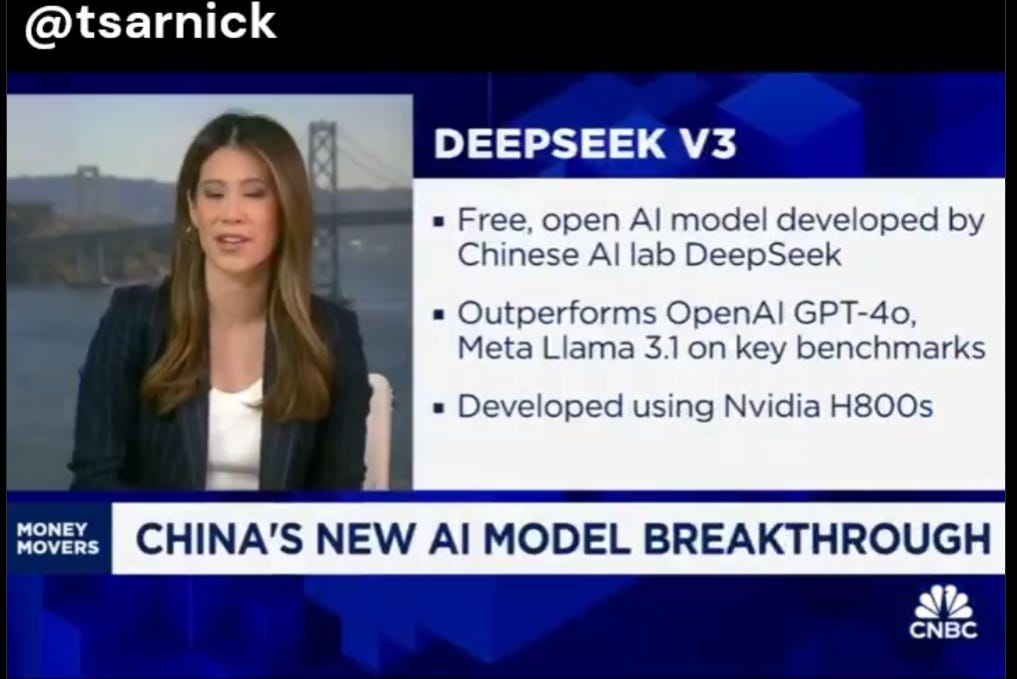
“Deepseek R1 is AI‘s Sputnik minute,” investor-billionaire Marc Andreessen composed on X.
“The release of DeepSeek, AI from a Chinese business, need to be a wakeup require our industries that we need to be laser-focused on completing to win.”
Despite the pomp and bombast of the Trump administration’s recent AI announcements, DeepSeek has increased fears that the U.S. might be losing its AI edge – especially since it’s been so effective despite the tight US export controls that prevent it from using Nvidia’s state of the art AI chips. The company’s newest achievement is a sobering counterpoint to Project Stargate, a joint endeavor between OpenAI, Oracle and Japanese tech corporation Softbank, to invest $500 billion in AI facilities.
Ahead of a meeting with House Republicans in Florida on Monday, Trump acknowledged the threat. “The release of DeepSeek, AI from a Chinese business, must be a wakeup require our markets that we need to be laser-focused on completing to win,” he said.

There are cautions to DeepSeek’s most current achievement. Researchers have actually found its AI designs tend to self-censor on subjects that are delicate to the Chinese Communist Party (CCP). Security researcher Jane Manchun Wong told Forbes DeepSeek’s models do not react to questions about Chinese President Xi Jinping and the 1989 Tiananmen Square protests. Beyond this, there are privacy issues. Data participated in DeepSeek’s models is kept in servers located in China, according to its policies.
Divyansh Kaushik, a vice president at national security advisory firm Beacon Global Strategies warned Forbes versus individuals utilizing DeepSeek without extensive vetting. “Unless we can have clear nationwide security and complimentary speech assessments of Chinese designs, they should be treated like propaganda arms of the CCP,” he stated. “They must be dealt with as Huawei on steroids.”
The issue is DeepSeek’s value proposition: a state of the art AI reasoning model that’s totally free to use and open in the closed, fee-based AI world being developed by business like OpenAI and Anthropic. “It’s better to have a Chinese model that is open source versus an American design that is closed source,” said Labelbox’s Sharma.